
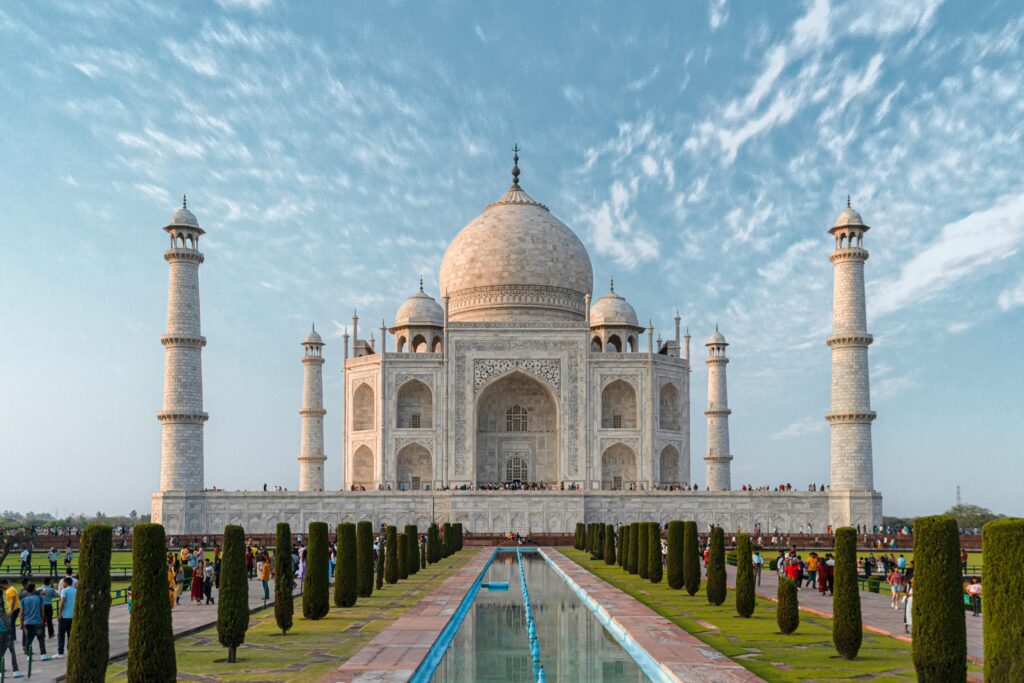
1. The Geometry of Grief
The Taj Mahal is famous for its perfect bilateral symmetry. Every minaret, arch, and dome is mirrored exactly, representing the Islamic concept of earthly paradise.
- The Irony: The only break in this perfect symmetry is the tomb of the Emperor, Shah Jahan himself, which was placed next to his wife’s tomb after his death.
- Visual Element:
2. A “Changing” Personality
One of the most poetic aspects of the monument is its responsiveness to light. Because of the translucent white Makrana marble, the building appears to change colors throughout the day:
- Dawn: A soft, pearly pink.
- Noon: A brilliant, blinding white.
- Moonlight: A ghostly, ethereal gold.
- Writer’s Tip: Use this as a metaphor for the many “phases” of love or memory.
3. The Art of “Pietra Dura”
If you want to focus on the craftsmanship, look into Pietra Dura (or Parchin Kari). This is the technique of inlaying polished, semi-precious stones (like lapis lazuli, jade, and crystal) into the marble to create intricate floral patterns.
- The Detail: Some of the tiny flowers on the interior tombs are made of over 60 individual pieces of stone, so finely joined that you can’t feel the seams with a fingernail.
4. The Legend of the Black Taj Mahal
There is a long-standing (though historically debated) myth that Shah Jahan planned to build an identical “Black Taj Mahal” across the river for his own tomb, connected by a silver bridge.
- The Hook: This adds a layer of “what if” and tragedy to your article, as he was imprisoned by his son before he could ever realize the second half of his vision.
5. Engineering Marvels of Taj Mahal
The Taj was built on the banks of the Yamuna River, which is tricky soil for a massive structure.
- The Secret: The foundation is made of a unique grid of ebony wood wells. This wood actually becomes stronger when kept moist, meaning the river itself acts as the “glue” that has kept the structure standing for nearly 400 years.